

Is negotiating your compensation just polite haggling? Nope! It’s a strategic conversation that can set the trajectory for your career.
Too many candidates jump at the first number on the table, especially the ones that have just started their professional career journey.
To get some real answers, we did a quick survey on the employees of our organization, and found that around 80% of candidates don’t accept the first offer outright. Instead, most take action to improve what’s on the table.
But salary negotiation doesn’t start after the offer – it starts with the right job search strategy. The roles you apply to, the salary range you target, and the way you position your experience all influence how much leverage you have later.
What Our Poll Revealed
We asked our community how they handled their most recent offer.
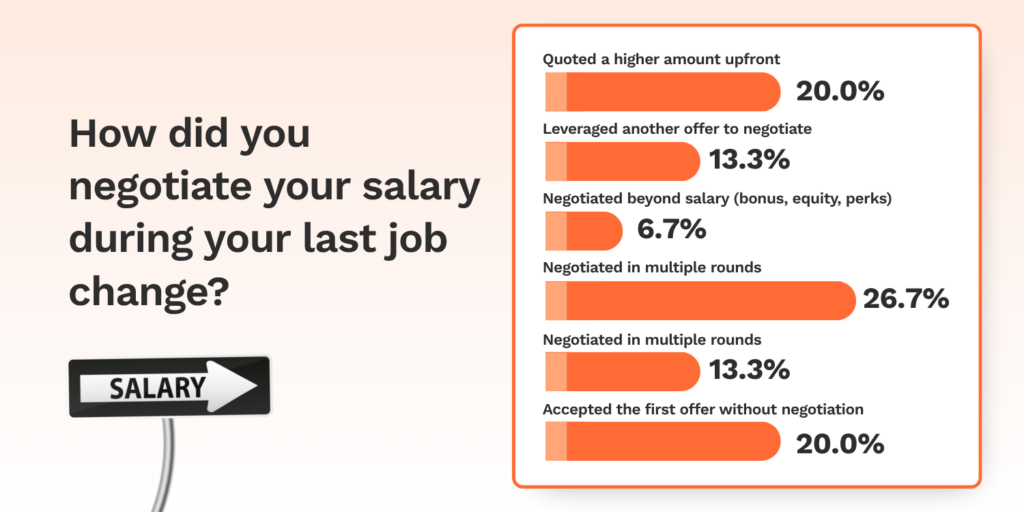
In fact, nearly 47% of candidates actively negotiate on the number itself – either by going through multiple rounds (26.7%) or directly quoting a higher amount (20%).
Others take a more informed or strategic route – about 26.6% strengthen their position by either researching benchmarks (13.3%) or using another offer (13.3%) as leverage. And while fewer candidates explore it, 6.7% negotiate beyond salary, focusing on benefits, flexibility, or long-term growth.
If you’re preparing to accept a new role, knowing how to negotiate salary after a job offer is one of the most valuable skills you can learn.
External research backs this up. A field study of almost 4,000 tech job seekers found that only 42% of candidates countered their initial offers, yet 85% of those who countered received at least part of what they requested. Those who negotiated saw compensation increase by about 12.45 % on average, worth roughly US$27,000 per year for the sample group.
How to Negotiate Salary After Receiving a Job Offer
An offer in hand feels like the end of the journey, but it’s actually your strongest point of leverage.
Before you accept, there’s a critical conversation to be had that can significantly impact your pay, role, and long-term growth.
1. Wait for the right time to finalize your package
Your leverage peaks after you’ve been chosen but before you accept. Wait until you have a written offer in hand. Express enthusiasm, request the full package in writing, and ask for a day or two to review. This pause allows you to research and craft a counteroffer without appearing disinterested.
Aim to negotiate between the offer and acceptance. Once you sign, the conversation is over. Most employers expect candidates to take 24–48 hours to decide, so taking time shows that you’re thoughtful rather than impulsive.
When you come back after reviewing the offer, how you open the conversation matters more than you think. Keep it simple, confident, and positive.
For example:
“Thank you for the offer – I’m really excited about this role and the team.”
“I’ve reviewed the offer and I’d love to discuss the compensation details before moving forward.”
This sets the tone as collaborative, not confrontational.
2. Know your worth and negotiate according to that
Before negotiating, understand what your market value actually looks like, not just what you hope to earn. Also, compensation isn’t just salary – it includes benefits, bonuses, and long-term value. Many candidates also confuse CTC and gross salary, which can impact how they evaluate an offer.
Start by looking at salary benchmarks for your exact role, industry, experience level, and city.
A Product Manager with 5 years of experience in Bengaluru may be paid very differently from someone in the same role in Kochi or Jaipur.
Use platforms like Glassdoor, AmbitionBox, LinkedIn Salary, and industry salary reports to get realistic ranges rather than relying on random numbers shared online.
You can also use AI job matching platforms to see whether the openings actually align with your experience level and compensation expectations.
But salary data alone isn’t enough.
Your value also depends on how difficult your skill set is to replace. Candidates with niche expertise, strong domain knowledge, or experience in high-demand tools often have more negotiating power than they realize.
For example, someone with hands-on AI hiring implementation experience or enterprise SaaS onboarding expertise may command a premium even if their title looks similar to others in the market.
It also helps to think beyond your current salary. Many professionals make the mistake of negotiating as a percentage hike from their previous compensation instead of evaluating the actual market rate for the role. If you’ve been underpaid in your current company, anchoring yourself to your old salary can limit your future earnings significantly.
Also consider the stage of your career. Early-career professionals may benefit more from learning opportunities, mentorship, and strong brand value, while experienced professionals often need to prioritize compensation growth, leadership exposure, or long-term financial upside. Knowing what matters most to you personally makes negotiation decisions much easier.
And remember that confidence during salary discussions usually comes from preparation, not personality. You don’t need to be aggressive or “good at negotiating.” When you understand your market value clearly and can explain the reasoning behind your expectations, the conversation naturally becomes more comfortable and professional.
3. Use another offer as strategic leverage, but only if you have one
One of the most effective yet underused negotiation strategies is leveraging another offer.
Interestingly, only 13.3% of the people in our quick survey used competing offers during negotiation, even though it significantly strengthens bargaining power.
A competing offer signals market demand and gives employers a benchmark for your value. But the key is to use it carefully – not as a threat, but as context.
Instead of saying, “Company X is offering me more.” Frame it like this:
“I’m genuinely excited about this opportunity, but I do have another offer in the ₹X range. If we can come closer on compensation, I’d feel much more confident moving forward with your team.”
This keeps the conversation professional and focused on alignment rather than pressure.
However, only use this strategy if the competing offer is real. Bluffing can damage credibility quickly, especially if the employer asks for timelines or details.
4. Frame a compelling case with facts and proper justification
Don’t merely ask for more – justify it. Back your counteroffer with market benchmarks, specialized skills, or certifications.
Your case becomes stronger when you highlight both hard skills (technical expertise) and soft skills (communication, leadership), especially if you’re helping bridge a skills gap in the role.
Share evidence of your achievements (e.g., revenue generated or goals exceeded) and how they translate to value for the employer.
Here’s how that might sound in a real conversation:
“Based on my experience in [specific skill/achievement] and what I’ve seen in the market, I was expecting something in the ₹X–₹Y range. Is there flexibility on the base salary?”
Or if you’re using data:
“From what I’ve researched, similar roles are typically in the ₹X–₹Y range. I’d love to understand if we can align closer to that.”
“When asking for additional compensation, be sure to provide one to two solid examples of why the company should invest more in you. It’s important to avoid asking for more money without any reason, much as you wouldn’t spend more of your money without understanding the value of the product.“
– Kate Palmquist, HR Specialist for over a decade
Negotiation is more than discussing base pay, but surveys show that only 6.7% of candidates negotiate beyond salary – such as performance bonuses, commissions joining bonuses, or other benefits.
5. Plan for alternate levers of compensation and explore the full package
However, these components vary by role and experience level. For example, commissions are more commonly offered in sales and revenue-linked roles, while performance bonuses are typically more relevant for experienced professionals and leadership positions.
Joining bonuses, on the other hand, are often used across mid to senior-level roles, especially when companies want candidates to make a quick switch. And for ESOPs, you need to stay in the company for an assigned amount of time to qualify.
Kate Palmquist also encourages, “Outside of income, you can also negotiate benefits, time off or other valuable perks.”
So, look beyond fixed salary and evaluate the complete package – bonuses, equity, insurance benefits, remote or hybrid flexibility, learning budgets, professional development opportunities, titles, relocation support, and even start dates.
If the employer can’t meet your salary expectation, discuss other elements like additional vacation days, flexible work hours, a joining bonus, or a future compensation review timeline.
So, if salary discussions hit the ceiling, don’t let the conversation stall. Try saying things like:
“I understand the constraints — could we look at other components like bonuses, ESOPs, flexibility, or a joining bonus to balance the offer?”
Even if you feel the salary itself is fair, there’s often room to negotiate on benefits, flexibility, bonuses, or long-term growth opportunities within the role.
6. Lead with enthusiasm, then negotiate with confidence
When you return to the employer after reviewing the offer, how you open the conversation matters more than you think.
Start by thanking them and reiterating your excitement about the role. This keeps the tone collaborative rather than confrontational.
For example:
“Thank you for the offer — I’m really excited about this role and the team.”
“I’ve reviewed the offer and I’d love to discuss the compensation details before moving forward.”
One important mindset shift here – don’t ask whether negotiation is allowed. Most employers expect some level of discussion, especially for experienced hires. Treat the first offer as the starting point, not the final number.
When discussing compensation, present your expectations clearly and back them with rationale. Research-backed salary ranges, relevant achievements, and role expectations strengthen your position far more than simply asking for “more.”
You could say:
“Based on my experience and the scope of this role, I was targeting something in the ₹X–₹Y range. Is there room to move in that direction?”
Remember to anchor slightly above your ideal target so there’s room for compromise, while keeping your tone respectful and solution-oriented.
7. Know when to walk away
Sometimes, despite negotiation, the employer simply can’t meet your minimum expectations. And that’s okay.
Accepting a role far below your financial or career expectations can impact your earnings trajectory and long-term satisfaction for years.
So unless you urgently need the role and don’t have a financial safety net, don’t be afraid to walk away from an offer that doesn’t align with your goals, lifestyle, or market value.
The right opportunity should feel like progress, not compromise at any cost.
FAQ
Can I still negotiate salary after receiving a job offer?
Yes, and this is actually the best time to negotiate. Once you’ve been selected, the company has already invested time and effort in you. Your leverage is highest before you accept the offer, which is why most negotiation conversations happen at this stage.
Can I lose a job offer for negotiating salary?
In most cases, no. Employers expect candidates to negotiate. What can hurt your chances is being unrealistic, aggressive, or making ultimatums without context. A well-reasoned, respectful counteroffer is rarely seen negatively; it’s often seen as a sign of professionalism.
What is the best way to start a salary negotiation conversation?
Start with appreciation, not demands. A simple structure works best:
- Acknowledge the offer
- Show excitement for the role
- Transition into discussing compensation
This keeps the conversation collaborative instead of transactional.
What is the 70/30 rule in salary negotiation?
The 70/30 rule suggests you should aim to speak only 30% of the time and listen 70%. Why it works: the more the employer explains constraints, budgets, or flexibility, the more insight you gain to adjust your strategy and push effectively.
How much should I counter a job offer?
A common approach is to counter 10–20% above the offer, depending on your research and confidence in your value. But the smarter move isn’t just how much—it’s why. Backing your ask with data, impact, or competing offers matters far more than the number itself.
Should I negotiate only salary or the full compensation package?
You should always look beyond salary. Many candidates miss this – your total compensation includes:
- Bonuses
- ESOPs and stock options
- Joining bonus
- Flexibility (remote/hybrid)
- Leaves
- Role/title
In fact, negotiating these can sometimes unlock more value for your future than base salary alone.
What if the company says the salary is non-negotiable?
That usually means the base salary has limits and not the entire offer.
This is your cue to shift the conversation:
- Ask about bonuses or performance reviews
- Negotiate an early salary revision timeline
- Explore additional benefits and perks
Good negotiators know when to change the lever, not just push harder.
What if I’m not getting offers that meet my expectations?
Sometimes the issue isn’t negotiation – it’s the opportunities themselves.
For example, if you’re expecting a higher salary but most of your offers are coming from roles that don’t match your experience level, the gap may be in the kind of jobs you’re applying to. A candidate with 4–5 years of experience applying to roles meant for 1–2 years will naturally see lower offers, no matter how well they negotiate.
In that case, focus on roles that match your current seniority, skill depth, and market value so the salary conversation starts from the right range.
How do I use another job offer in negotiation without sounding pushy?
Use it as context, not a threat.
For example:
“I’m currently considering another opportunity in the ₹X–₹Y range, but I’m genuinely more interested in this role. Is there flexibility to align closer to that?”
This shows intent and leverage, without burning bridges.
When should I NOT negotiate salary?
Avoid negotiating if:
- The offer already exceeds your expectations significantly
- You lack market data to justify a counter
- The role has clear, rigid pay bands (e.g., some early-stage or structured orgs)
That said, even in these cases you can still explore non-monetary benefits.
How long should I take before responding to an offer?
24–48 hours is standard and expected.
Rushing can weaken your position, while taking time(not a lot) signals that you’re thoughtful and serious about the decision.