Instead of relying only on external hiring or static job descriptions, companies are now adopting dynamic, AI-driven systems that continuously match people to work.
Traditional hiring is slow, reactive, and often wasteful. Meanwhile, roles are evolving faster than ever, skills are becoming outdated quickly, and talent shortages are increasing globally.
AI talent marketplaces solve this by making talent fluid, visible, and deployable instantly.
What is an AI Talent Marketplace?
An AI talent marketplace like ZappyFind is a platform that uses artificial intelligence to match recruiters with pre-screened candidates and candidates with real, active job opportunities based on skills and experience.
“[With AI talent marketplace] Instead of starting from scratch for every role, hiring teams tap into a living, evolving talent ecosystem – where the right candidates are already within reach, just waiting to be matched.”
– Jyothis KS, Co-founder of Zappyhire
Unlike traditional hiring systems that rely on keyword matching or manual screening, these platforms:
- Analyze skills and competencies deeply
- Predict role fit and success probability
- Continuously learn from hiring outcomes
- Recommend candidates proactively
In simple terms, it’s like having a smart recruitment engine that connects the right talent to the right role faster and more accurately.
How Does an AI Talent Marketplace Work?
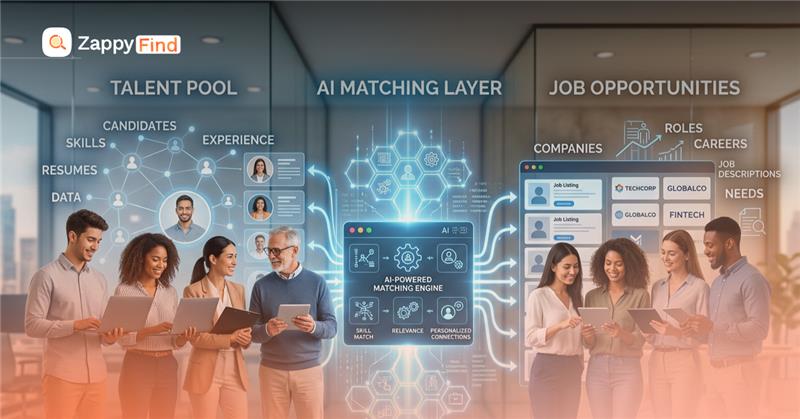
An AI talent marketplace brings together fragmented candidate data, evaluates it at scale, and turns it into actionable matches for hiring teams.
“AI‑enabled recruitment is shifting organizations from hiring by job title to hiring by skills, experience, and potential. Talent marketplaces are becoming the operating system for modern talent ecosystems.”
– Josh Bersin, HR analyst and Talent‑strategy Advisor
For recruiters, the process starts with sharing a job requirement on the platform. The AI analyses the role, builds an ideal candidate profile, and scans the platform to surface the most relevant, pre-screened candidates.
After that instead of receiving hundreds of applications, recruiters get a ranked shortlist of qualified profiles with each being matched on skills, experience, and role fit – making this kind of systems perfect for skills-based hiring.
Every action the recruiter takes in shortlisting, rejecting, hiring – teaches the system to improve future recommendations.
“As a direct response to the growing use of AI candidate matching technologies, recruitment strategies will shift in a major way toward skills-based hiring.”
– Victoria Myers, Global Head of Talent Attraction at Amdocs
For candidates, it starts with signing up and sharing their skills, experience, and career goals. The AI instantly maps their profile against active job openings and recommends the most suitable opportunities at companies that are actively hiring.
Here’s are some key components on how that typically plays out:
Talent aggregation from multiple sources – Talent marketplace platforms continuously pull in candidate profiles, from your existing ATS database, career pages, referrals, and external sources; creating a unified, searchable talent pool.
AI-driven profile enrichment – AI parses and enriches each profile by identifying skills, experience depth, career progression, and contextual signals.
Platforms like ZappyFind, for example, reach out via AI-powered screening calls to each and every candidate to gain deeper information so that the platform can dole out accurate matches to hiring teams.
Intelligent matching, not keyword filtering – Unlike traditional systems, matching isn’t based on exact keyword overlap. AI models evaluate role requirements against candidate profiles to identify high-fit talent – even those who may not look obvious on paper but have transferable skills or relevant experience.
Continuous ranking and re-discovery – As new roles open or requirements evolve, the system automatically re-ranks candidates in your database. This means previously overlooked profiles can resurface at the right time, reducing dependency on fresh sourcing every time.
AI Talent Marketplaces vs Normal Job Posting Sites
| Aspect | AI Talent Marketplaces | Normal Job Posting Sites |
|---|---|---|
| Matching Approach | AI-driven matching based on skills, experience, behavior, and fit | Keyword-based search and manual filtering |
| Speed to Hire | Faster – automated shortlisting and instant recommendations | Slower – requires manual screening of large applicant pools |
| Candidate Discovery | Proactively surfaces best-fit candidates (even passive talent) | Relies on candidates actively applying |
| Screening Process | Automated screening, scoring, and ranking | Manual resume screening by recruiters |
| Quality of Matches | Higher accuracy due to data-driven matching models | Varies – often includes many irrelevant applications |
| Recruiter Effort | Low – automation handles sourcing,screening, and ranking | High – significant manual effortrequired |
| Candidate Experience | More personalized and relevant opportunities | Generic application process with limited personalization |
| Scalability | Easily scalable across roles and geographies | Limited by recruiter bandwidth |
| Outcome Focus | Optimized for better hiring outcomes and fit | Focused on generating applications |
What are the Benefits of AI Talent Marketplaces?
1. Faster Hiring Cycles
A talent marketplace reduces the manual effort of digging through hundreds of resumes or waiting for applications to come in. The system already has a ranked list of candidates who fit, ready when you need them.
2. Better Quality of Hire
It’s not just about who looks right on paper. AI looks deeper into skills, patterns and brings you candidates who are actually more likely to succeed in the role.
Data‑driven matching looks beyond keywords to evaluate behavioral competencies, potential and culture fit.
As many as 89% of talent‑acquisition professionals believe measuring quality of hire will become increasingly important, yet only 25% feel highly confident in doing so. Importantly, 61% believe AI can help improve quality‑of‑hire measurement.
Companies that prioritize continuous learning and predictive analytics alongside AI talent marketplaces – for example through AI assessments, robotic video interviews and candidate pre‑screening tools – can identify high‑potential talent earlier in the process.
3. Reduced Dependency on Fresh Sourcing
One of the biggest inefficiencies in hiring is re-doing the same work for every role. With an AI talent marketplace, your existing database becomes reusable. This means candidates you’ve already seen (or even rejected earlier) can resurface when they’re a better fit.
4. Unlocking Hidden Talent
It is a common scenario that some of the best candidates may not tick every keyword box and traditional systems end up filtering them out, but AI talent marketplaces bring them back in by recognizing transferable skills and potential.
5. Improved Recruiter Productivity
Some AI talent marketplaces like ZappyFind does the first round of screening candidates with AI agents which allows recruiting teams to focus on talking to top candidates, making decisions, and improving the overall hiring experience, instead of spending hours screening and shortlisting.
“AI will play an important role in unlocking efficiencies in how People teams operate, but it won’t replace the essential human elements, like empathy, communication and relationship building.”
– Jennie Rogerson, Global Head of People at Canva
6. More Personalized Candidate Experience
AI marketplaces offer tailored recommendations and real‑time feedback, improving candidate engagement.
FAQs
What is an AI talent marketplace in simple terms?
An AI talent marketplace is a smart platform that automatically matches employers to the right candidates and candidates to the right jobs using data like skills, experience, and potential.
How is it different from a normal sourcing platform?
Traditional sourcing platforms depend on keyword searches and manual filtering.
AI talent marketplaces go beyond that by understanding candidate profiles deeply and proactively recommending the best-fit talent, even if they didn’t apply.
Who should use an AI talent marketplace?
It’s ideal for organizations with ongoing hiring needs, large candidate databases, or multiple roles to fill. It is especially useful for teams looking to improve hiring efficiency, reduce manual work, and scale recruitment.
Does it replace recruiters?
No, it augments them. AI handles repetitive tasks like initial screening and manual searches, while recruiters focus on the right candidates, relationship building, and delivering a better candidate experience.
“Accept the fact that AI will change our work, but look at it as an enabler of your work and the future of talent acquisition.”
– Przemek Berendt, VP of Global Marketing, Luxoft
